
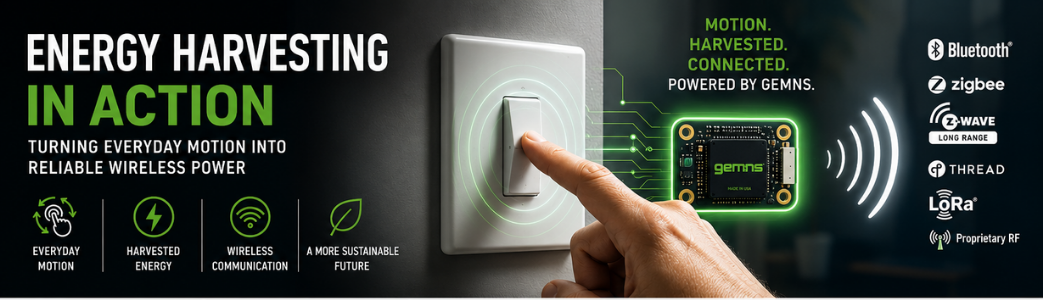
What if those motions could also help power the future?
Every day, millions of people press buttons, flip switches, open doors, slide controls, and interact with machines without giving those actions a second thought.
The action is brief. The energy is wasted.
Or is it?
What if those everyday motions could do more than perform a task? What if they could generate the energy needed to communicate, trigger an event, or report critical information without relying on batteries or wired power?
That question is reshaping how engineers think about product design.
The opportunity isn’t defined by a specific industry. It’s defined by motion.
Looking Beyond Batteries
For decades, wireless devices have relied on batteries or AC as their primary power source. While batteries enabled the growth of IoT, they also introduced an unavoidable challenge: every battery has a limited lifespan. That means maintenance visits, downtime, added costs, and environmental waste.
As wireless devices continue to multiply, maintaining thousands of batteries becomes increasingly impractical.
Energy harvesting offers a solution to that challenge, capturing energy exactly when it’s needed.
The Common Thread Isn’t the Industry. It’s the Motion.
When people think about energy harvesting, they often ask:
“What can it power?”
The better question is:
“Where does motion already exist?”
Once you begin looking through that lens, opportunities begin to appear everywhere.
A light switch doesn’t just turn lights on. The flip of the switch is raw, unused energy.
A door doesn’t simply open. The operation of opening and closing it generates movement.
A push button isn’t only an input. It’s a source of usable energy.
Those small mechanical actions happen millions of times every day across homes, commercial buildings, factories, hospitals, schools, transportation systems, and public spaces.
Each one represents energy that has traditionally gone unharvested.
Today, it can become the power source for reliable battery-free communication.
Designing For Movement
Moving away from designing with batteries and toward designs that utilize natural movements is becoming one of the biggest shifts in product development.
Instead of asking:
“Where can we fit a battery?”
Engineers can begin asking:
- Where is someone already pressing something?
- Where is something already moving?
- Where can existing motion become energy?
That simple change in thinking opens the door to entirely new product possibilities.
Motion Is Everywhere
Consider how many everyday interactions could become opportunities to generate power.
In commercial buildings:
- Light switches
- Accessibility buttons
- Occupancy controls
- Door and window sensors
- Perimeter monitoring and access control
In industrial environments:
- Limit/Safety switches
- Push buttons
- Equipment controls
- Status indicators
Across facilities:
- Leak detection
- Mechanical room monitoring
- Utility spaces
- Equipment access points
In outdoor infrastructure:
- Gate monitoring/controls
- Access points
- Lighting controls
- Temporary installations
These aren’t isolated applications. They’re examples of a much broader principle:
Where motion exists, energy may already be available.
Why This Matters Now
Energy harvesting isn’t new.
What’s changing is what can now be done with the harvested energy.
Advances in energy harvesting technology are enabling more usable energy from everyday mechanical actions, making it possible to support reliable communication across protocols including Bluetooth, Zigbee, Z-Wave Long Range, Thread, LoRa, and proprietary RF solutions. Gemns has recently demonstrated its ability to harvest sufficient energy for electromechanical devices (such as latch locks).
This means designers must no longer choose between wireless convenience and ongoing battery maintenance.
They can begin eliminating batteries altogether in applications where motion already provides the required energy.
Rethinking Design
Perhaps the most exciting aspect of energy harvesting isn’t a single product.
It’s the mindset.
When designers stop seeing a button as just a button, or a door as just a door, they begin recognizing every interaction as a potential source of energy.
That shift changes how products are imagined. It affects how buildings are maintained and how wireless systems are deployed.
Ultimately, it changes how the next generation of connected devices will be powered.
The Future Is Powered by Motion
The future of IoT won’t be defined simply by adding more connected devices.
It will be defined by making those devices smarter, simpler, and easier to maintain.
Not every application will eliminate batteries, but many don’t need them in the first place.
Every press.
Every flip.
Every slide.
Every turn.
Every opening and closing.
These everyday moments occur billions of times worldwide, creating opportunities to harness long-overlooked energy.
The question isn’t whether energy harvesting can replace batteries everywhere. It’s whether we’re ready to start seeing motion as more than movement.
Once you do, the possibilities are everywhere.
About WePower Technologies
At WePower Technologies we develop Gemns™ high-performance kinetic energy-harvesting technology that converts everyday mechanical motion into usable electrical energy, enabling reliable, battery-free solutions for commercial, industrial, and IoT applications. Eliminating batteries and reducing maintenance to design a more sustainable, resilient, and connected future.